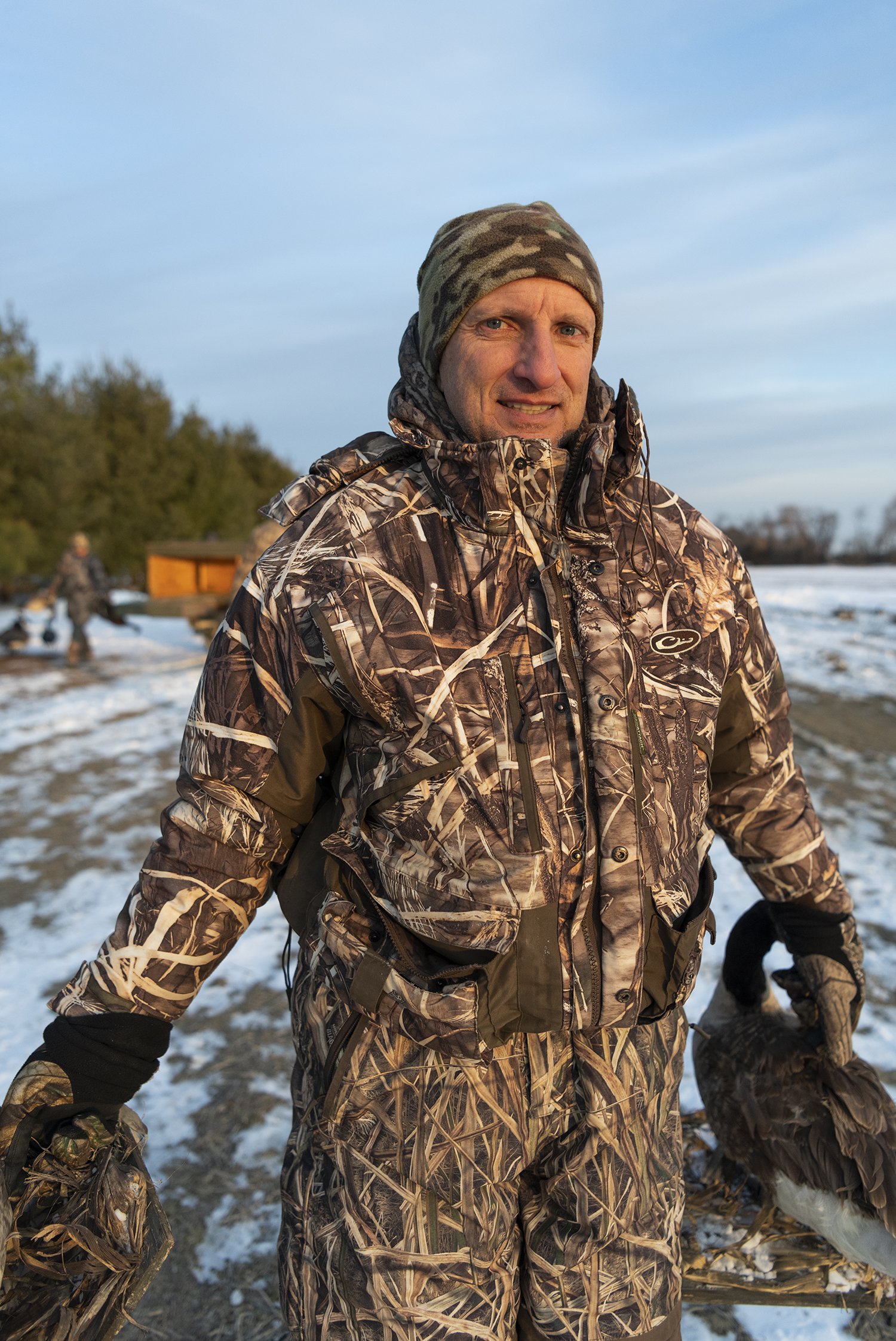
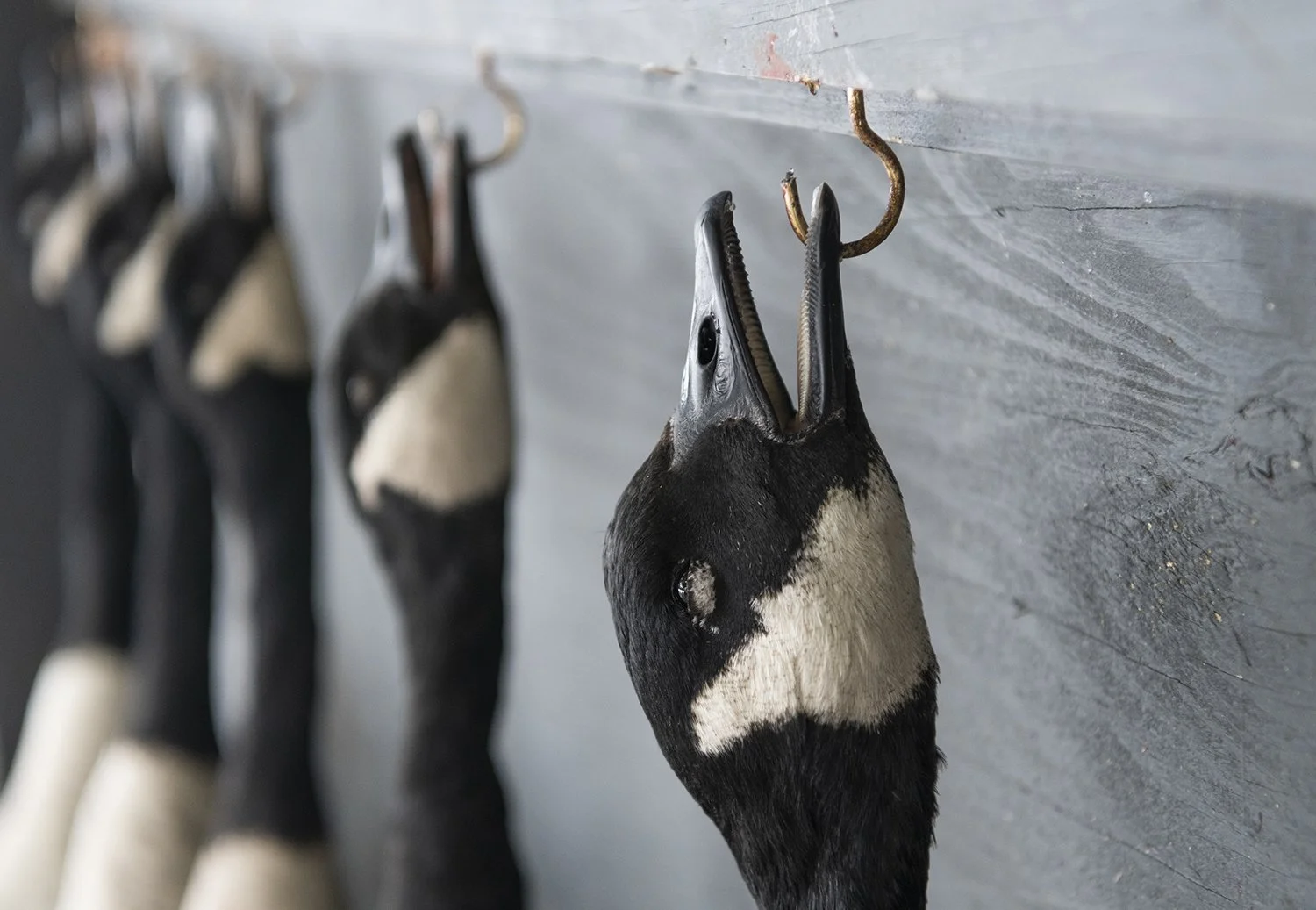
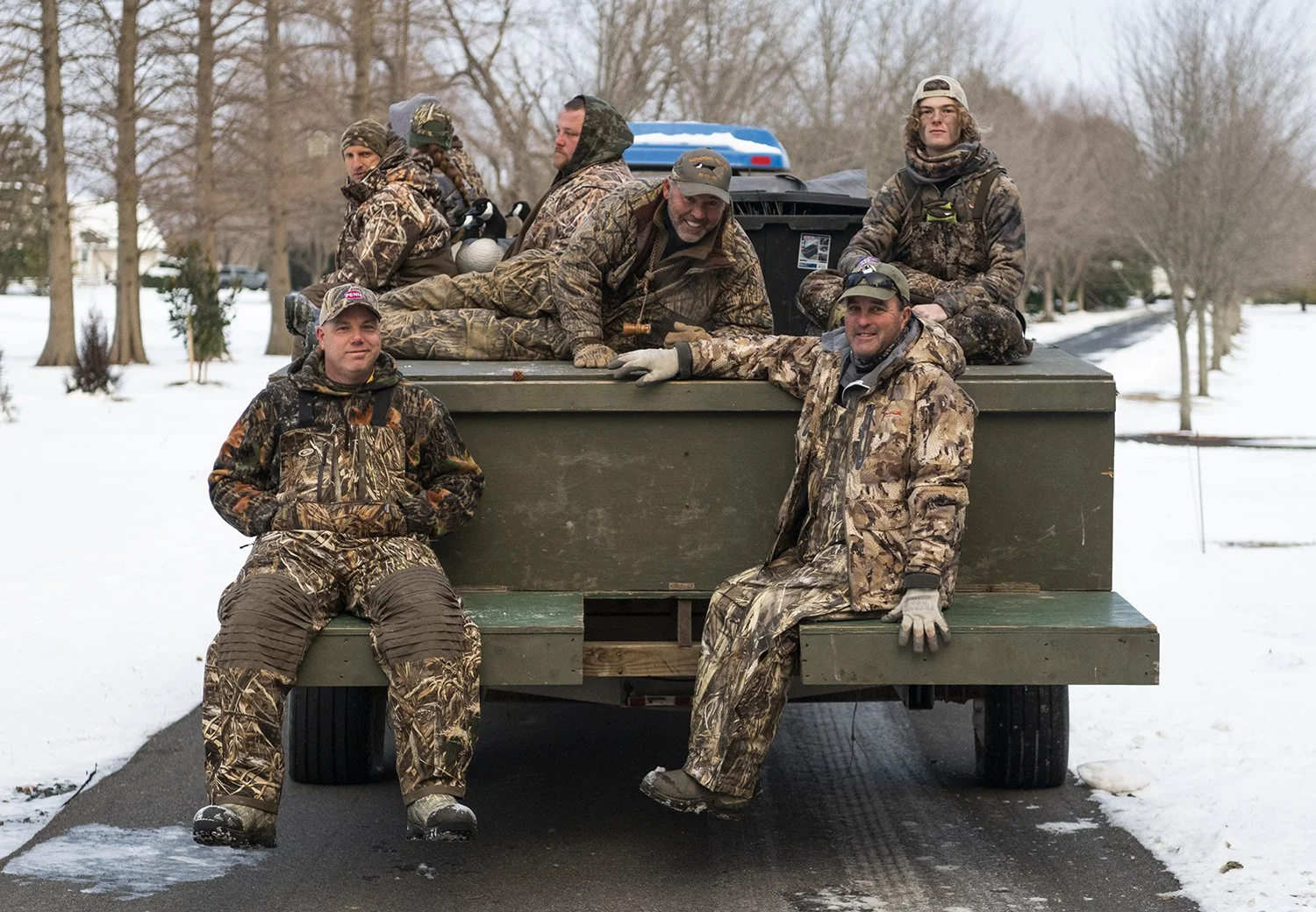
Hunting for Canada geese on the last day of the 2021-2022 Maryland waterfowl season from a blind near Kirwan Creek on Kent Island.






Your Custom Text Here
Hunting for Canada geese on the last day of the 2021-2022 Maryland waterfowl season from a blind near Kirwan Creek on Kent Island.


I frequently get asked about the difference between the archival canvas prints and the archival paper prints that I have available for sale on my website’s shop. Both the canvas and the paper prints are done using the same printer but the difference lies in the framing and mounting process and the presentation of the piece after being framed.
My prints are all done in house at my studio on Kent Island, Maryland. Having the ability to print my own work gives me final control of the finished piece, I frequently find myself doing test prints to ensure that the color matches what I saw while out capturing the photograph and the retouched image that the computer is displaying. All of the prints, both paper and canvas are done on an Epson p9000. The printer can handle a variety of media - from standard weight proofing paper to 1.5mm thick poster boards. The printer can accommodate rolls of paper or canvas up to 44” which allows me to make oversized prints up to 44”x96”. The ten inks that the printer uses give the prints an incredible dynamic range and are archival for up to 200 years. There is very little risk of the prints fading due to exposure from UV light.

Printing an oversize canvas - 38”x77” on the Epson P9000 at my studio.
When choosing to have a print done on paper or canvas, it is important to think about where the print will be displayed. During the framing process, paper prints are traditionally covered with glass which will result in glare unless a museum quality glass is chosen. Canvas prints are traditionally not covered by glass and the result is no glare. I frequently ask customers where their prints will be displayed and if the room has abundant ambient light. If the prints are destined for a room with abundant light, I will frequently steer customers in the direction of a canvas print or recommend using museum quality glass when having a paper print framed to eliminate and reduce glare.


The two photographs above show framed paper prints displayed in a room with abundant natural light from a large window. The prints on the left is has standard glass and the print on the right has museum quality glass - both prints were photographed from the same angle but as you can see the amount of glare is significantly less on the print with museum glass. For paper prints, I always encourage the use of museum glass - the only issue with museum glass is that the cost is significantly higher - approximately three times higher than the cost of standard glass.

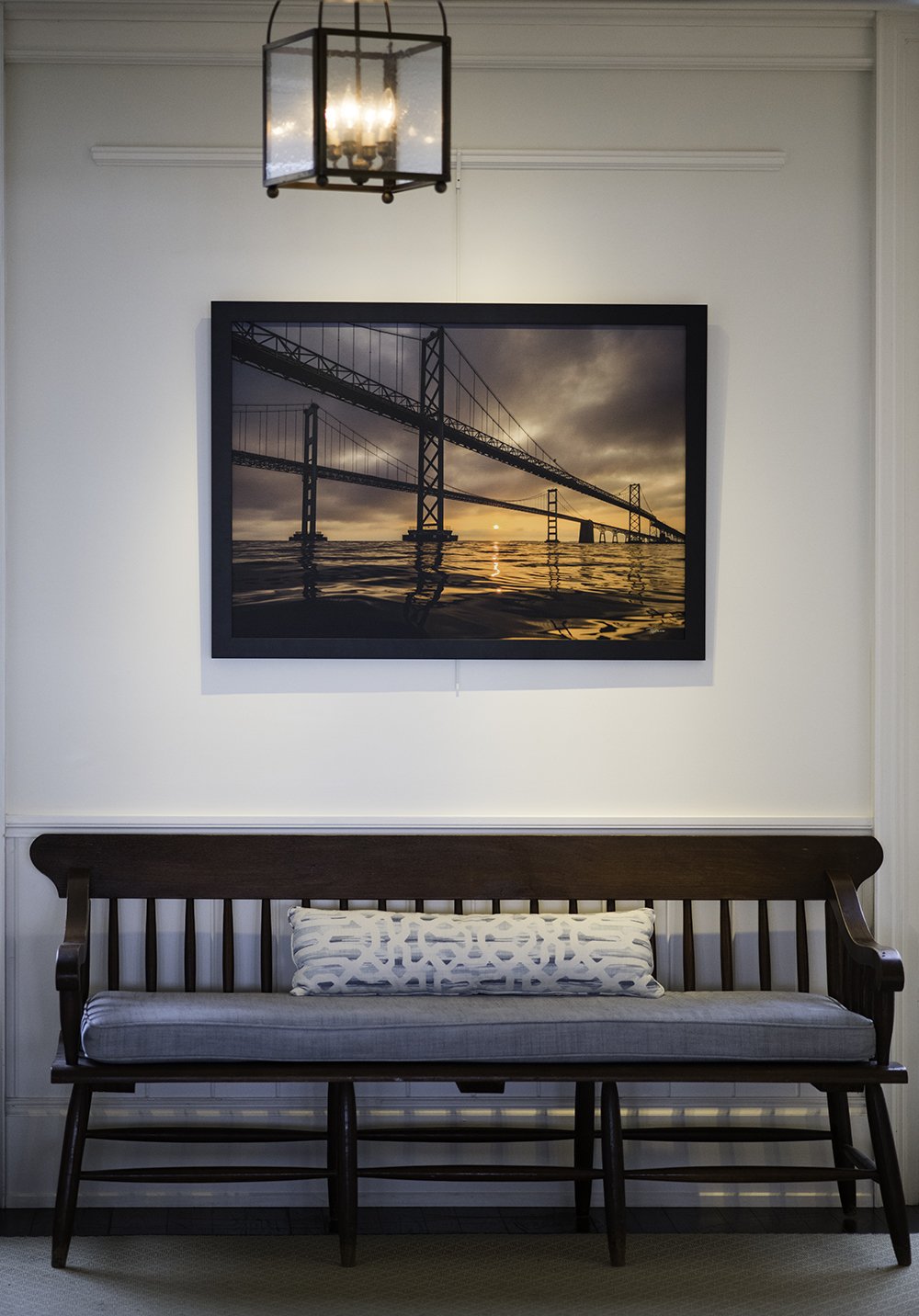
The photograph above shows a framed canvas print displayed at the exact location as the two paper prints in the previous photograph - in a room with abundant natural light. Note that there is no glare from the ambient light on the canvas print.
The main difference in framing a paper print versus a canvas print is that paper prints are traditionally framed with a matte surrounding the piece of art and glass to protect the print. Canvas prints, and even paintings on canvas do not typically have a matte border or glass in front of the art.
My framer and I have developed a method of handling the canvas prints during the framing process. mounting and varnishing the canvas prints. Years of working with hundreds, if not thousands, of canvas prints has allowed us to perfect this process to ensure the protection and longevity of the finished piece.
After delivery from my studio to the frame shop, the canvases are mounted to a flat rigid board using an adhesive. The board used is a thin PVC composite material that will not warp or bow with fluctuations in temperature or humidity - it will stay flat under different conditions. This method was developed to replace the process of stretching a canvas using wooden stretcher bars and staples.
Once the print is mounted and flat, the framer coats the print with a varnish that protects the canvas from minor abrasion, water, dust and also provides additional protection from UV light. In a dust free room, multiple coats of the varnish are applied using a a lint free roller. After drying, the print is trimmed to the edge and is ready for the final stage - adding the frame.
The term “gallery wrap” that is typically associated with a canvas print refers to the stretching process. Gallery wrapped canvases have the image stretched over the edge of the stretcher bar and can be hung without a frame. Gallery wrapped canvases leave the edges of the print exposed and vulnerable to damage. A frame added to a mounted canvas print will protect the edges of the print and also add rigidity and structural integrity to the final piece. The addition of a frame may add cost to the final piece but it is a much better way to display a canvas print for the long term and adds a more finished look to the art. A variety of frames in different styles, shapes and colors are available from my framer.
Scroll through the gallery of photographs above to see a selection of canvas prints installed in homes, offices and restaurants in the Chesapeake region.
Paper prints can be done on my Epson p9000 using a variety of different paper types. I stick to using either an Epson watercolor/fine art paper or a matte paper with a ultra-smooth finish. When paired with epson inks, these papers have incredible dynamic ranges and color gamuts.
Paper prints are mounted to a flat rigid board using either a heat activated adhesive. Unlike the canvas prints, the paper prints are not varnished after mounting. Typically a matte that is cut proportionally to the size of the print is used to create a border between the print and the frame. A matte is not required for framing a paper print - the edge of the print can go directly to the frame just as it does with a canvas print. Matte boards come in a variety of colors and thicknesses. 4 ply is a standard thickness and 8 ply is considered double thick. The use of a thicker matte board or even multiple mattes can add depth to a finished piece. The opening on the matte boards that will fit the print is cut using a computerized matte cutter.
After the matte is cut and place on top of the print, the next step is to cut and join the frame. Frames are selected based on a number of different factors - the colors/tones in the print, matching the decor/feel in a room and budget. There are hundreds of different moldings available through the distributors that my framer works with. I stick with a handful of frames that tend to work well with many different prints and decor styles - blacks, brushed silvers, natural woods tones, etc..
When the frame is cut and joined, then the desired glass is cut to fit within the frame and the piece is assembled and the hanging hardware is added.

An example of framed paper print with a white matte, museum glass (glare reducing) and a black frame.


For additional questions about the framing process please call Jay at 410-279-8730
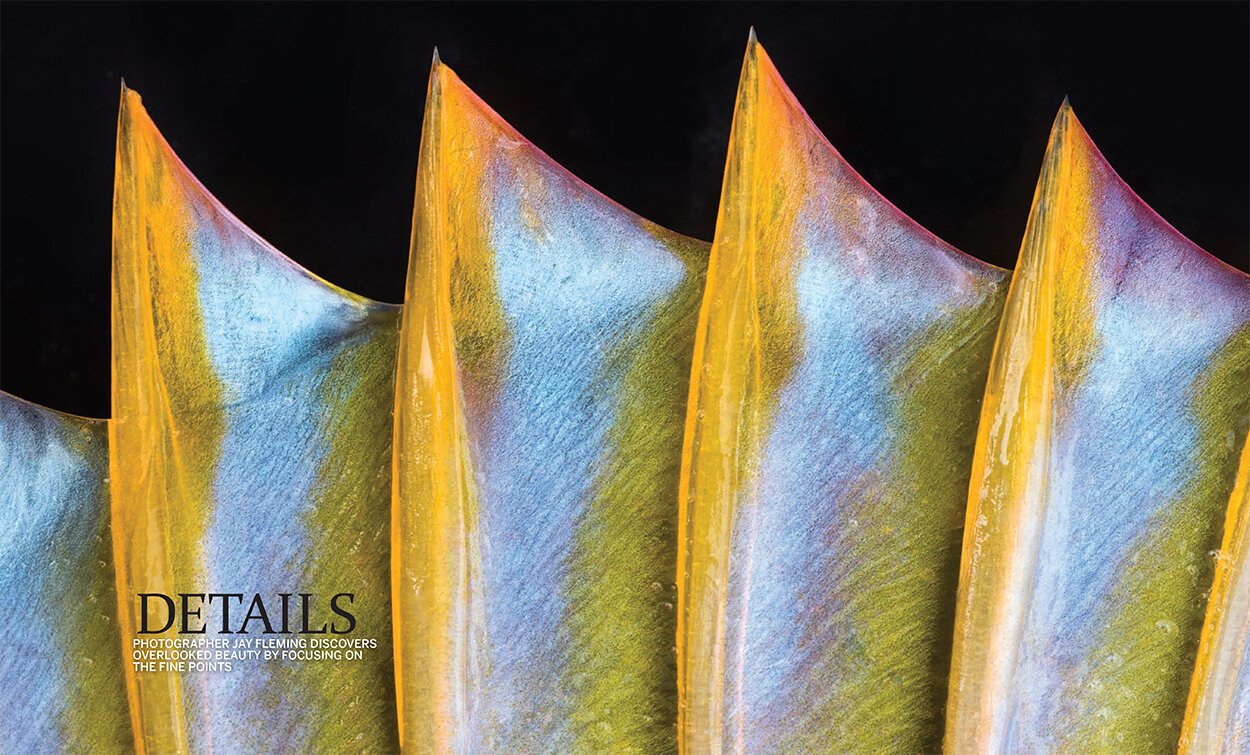
Details of fish scales, fins and eyes shot on the water almost immediately after the specimen was pulled out of the water. When focusing on such a small part of a fish, it is easy to become mesmerized with the patterns and colors. Shooting with a Marco lens (60mm) that has such a narrow field of view can be a challenge from a moving boat. A selection of these images that are featured in the bottom portion of this post were originally published by Anglers Journal magazine in the spring of 2016.




The cover of Volume 14 of the Delmarva Review features a photograph of crab shanties in Tangier Island’s mailboat harbor at dusk .
A thoughtful and thorough review of Island Life by writer and publisher Wilson Wyatt that originally appeared in the Delmarva Review . Wyatt’s annual publication is a literary journal dedicated to the discovery and publication of compelling new fiction, poetry, and creative nonfiction from emerging and established writers of all backgrounds.
Copies of the Volume 14 (2021) of the Delmarva Review are available for purchase.
PHOTOGRAPHS MARK OUR EXISTENCE IN TIME; the camera becomes a clock for seeing, to borrow from Roland Barthes in Camera Lucida. About a dozen years ago, photographer Jay Fleming began a quest to document Chesapeake Bay life on two of the last inhabited islands in the Bay—Smith Island, Maryland and Tangier Island, Virginia—the focus of his latest narrative photography book, Island Life.
Island Life is an important contribution to building an understanding of Chesapeake Bay life— now and in the future, above and below the surface. Smith and Tangier islands are surrounded by and dependent on the Chesapeake Bay, the largest estuary* in the United States and one of the five largest in the world. I recommend Fleming’s book for its beauty as well as its living narrative about the history and current life of this region and its place on our planet.
Fleming has a passion for photography and life on the water. Having photographed the last house on Holland Island, months before its collapse into the Chesapeake, in 2010 (p. 54), and photographing life on the bay for his first book, Working the Water (2016), he began a serious journey to document-in-time life on the islands featured in this book.
...I was motivated by a deep desire to capture a moment in time for these incredible islands, as the very forces that sustain them also threaten to take them away.
The book is divided into three sections: Island Scape, Way of Life, and Harvest. Together, they tell stories about Tangier Island, Smith Island, islands of the past, wildlife, and even life underwater. As he worked on this book, he became familiar with the people who live on the islands....their communities, strong sense of identity and public service, religion, education, their work, food, hunting, and how they approach health care, and off- island jobs from such a remote region. The Harvest section describes the economic and human requirements of running family businesses built on fisheries, harvesting crabs, oysters, and other seafood—dependent on long hours of commitment, all at the mercy of nature, through the seasons. The ending is, appropriately, “the blessing of the fleet.”
This book captures a pivotal moment in time for Smith and Tangier, documenting the ways their culture and environment are shaped by isolation from the mainland and the forces of the Chesapeake Bay.
In addition to his photography business, he developed a series of photographic workshops to lead interested amateur photographers to the islands capturing images of “the abundant wildlife, beautiful landscapes, and iconic working waterfronts and watermen.”
Fleming renovated an old 22-foot center console fishing boat to navigate the waters for the workshops. Over the years, since his last book, he and his workshop explorers interacted with the island inhabitants and the surrounding natural environment. The stories of the islanders are authentic and personal, far different than what a reader might expect from a photo book.
As he became familiar with the islander families, he developed a deep understanding of the changes to the islands due to climate change and associated sea-rise. To be precise, however, the book is not a treatise on climate change. Fleming leaves that realization to the reader. Instead, the book’s photos and narration document the uniqueness of island life, in time, with caring attention to detail and the human passion that weds the islanders to a life dependent on the surrounding bay
For those readers who enjoy photography, Fleming’s 271 images (most in color) will treat readers to fine landscapes, seascapes, sunsets, sunrises, and vessels and watermen at sea, under various climate conditions. The images also reveal the unique island life on land, with diminishing shorelines. Some images are touching—some are surprising. He includes artistic underwater photographs, as well as seascapes. For “foodies,” there are even photos showing the construction of Smith Island cakes.
If you treasure the Chesapeake, Island Life belongs on your history shelf or coffee table. It is bound to increase your knowledge and appreciation of Chesapeake life and this unique place on Earth.
ISLAND LIFE, by Jay Fleming
©2021 - Jay Fleming, 280 pages, 271 photographs, ISBN 978-0-9977468-1-5
Follow Jay’s work on Instagram and Facebook